Door: John Sumners | 18 augustus 2026
It was a revelatory shock. Ages ago, on my first-ever trip to Porto, I stood in a bottle shop, dumbfounded by the abundance of Portuguese traditional-method sparkling wines on the shelves. Why is Portuguese bubbly not a thing elsewhere? I wondered.
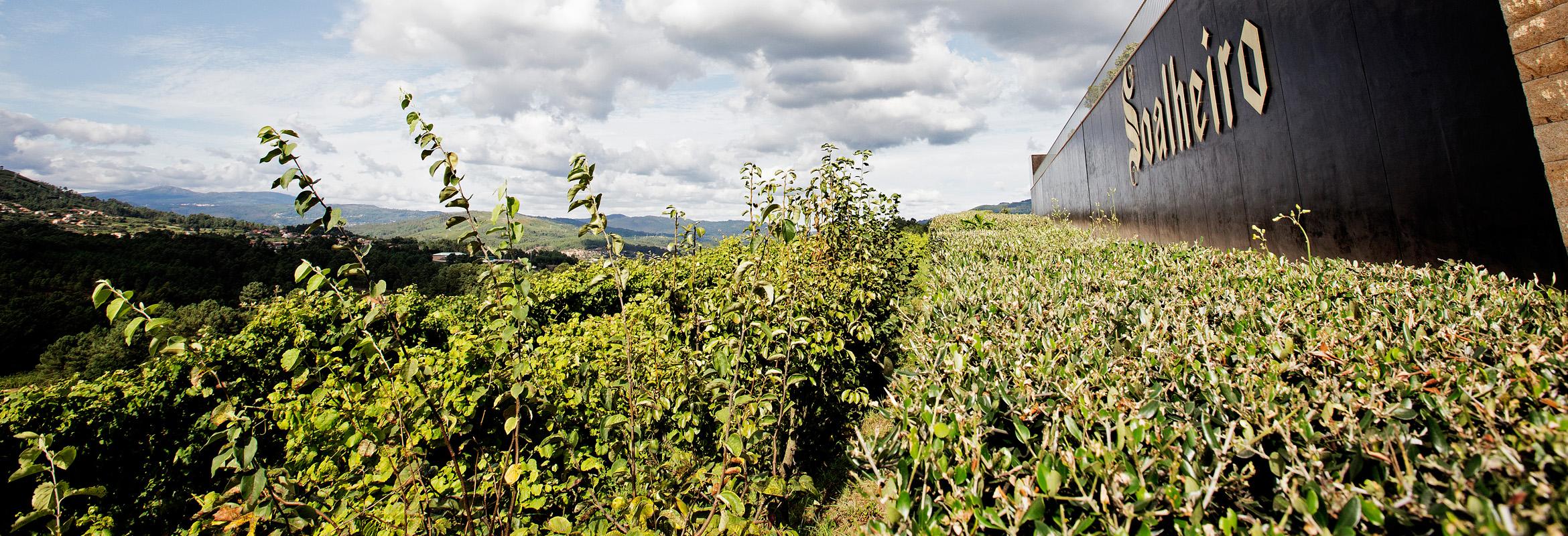
Historically, Portugal is one of the last places you’d expect to find Champagne-style wines. The average drinker is completely oblivious to the country’s high-quality traditional-method bottlings—they are the Mr. Cellophane to Vinho Verde’s Roxie Hart, for the Chicago fans out there. But the Portuguese sparkling landscape has been evolving, with producers slowly making international inroads here and there. And in what can still be a stubbornly patriarchal industry, it’s notably women winemakers who have been bubbling to the top. Soalheiro, on its perch in Portugal’s far northwest, opposite Spain’s Galicia.
From France With Love... And a Side of Sardines
The Portuguese realize the sparkling world still revolves around those chalky hills billowing out from Reims and Épernay. They’re not here to reinvent the wheel or claim the crown. They’re just trying to give Champagne’s venerable heritage an inimitable Lusophone accent. It all began by the ocean, in the weather-beaten basin of Bairrada. Local lore holds that Napoleon’s troops introduced Champagne-method production to the area during their ill-fated invasion of Portugal in the early 1800s. The Portuguese-British alliance drove the French out in 1811, but it wasn't until the 1890s that Portuguese wineries began producing sparkling wine on a commercial scale. Now, with all things fizz in fashion, and with Portugal’s international profile continuing to surge, the country’s overlooked traditional-method wines may finally have a fighting chance to carve out serious space in markets abroad.
The Other, Other Vinho Verde
North of Bairrada, in the corner of the country known for “green wine,” a revolution of sorts has been underway. “Vinho Verde is not the obstacle. The simplification of it abroad is,” lamented Maria João Cerdeira, co-owner at Soalheiro in the far northern reaches of the Minho region. The inexpensive, fizzy style known to supermarket coldboxes worldwide—not that there’s anything wrong with it—has left the region a victim of its own mass-market success. “Vinho Verde is a diverse region, with distinct subregions, noble grape varieties, and the capacity to produce serious wines, including traditional-method sparkling,” she insisted. Her family’s estate, a household name for still wines since 1974, raised the bar for regional fizz with Iberia’s first traditional-method Alvarinho back in 1995. Originally a veterinarian by trade, Cerdeira returned to work at the family business several years ago, and now oversees the entire operation. In 2024, another woman, the gifted Asun Carballo, ascended to lead the winemaking team, forming a formidable duo that is now pushing the winery toward new heights.
Vinho Verde is not the obstacle. The simplification of it abroad is.
Maria João Cerdeira, Soalheiro co-owner: “What first caught my interest was not the [Champagne method] itself, but the idea that Alvarinho - a variety so deeply identified with our region as a still wine—could express itself in a completely different language,” Cerdeira said. Other local varieties, like Loureiro and Azal, are more easily tamed into a balanced sparkling. With Alvarinho, it’s a tightrope walk to capture its special aromatic flamboyance while holding onto restraint and finesse. “For sparkling, we return to the roots of the variety: lower alcohol, lower pH, higher natural acidity, and more linearity,” she explained. “[It’s] a base wine that holds back, allowing time on lees to shape its complexity.”
Vinho Verde and the Minho region are coming of age, shedding the reputational shackles of cheap-and-cheerful supermarket wine and a patriarchal mentality. “We are seeing a new generation of women in Portuguese wine taking on leading roles, bringing a complementary sensibility - attention to detail, long-term thinking, and care for both people and place,” she said. “It’s not a coincidence, but neither is it a movement defined by gender. It reflects how the industry itself is evolving.”
Mining Portugal's Mountainous Core
Meanwhile, to the southeast, Marta Lourenço is ensuring that Portugal’s most beloved traditional-method winery remains an icon. Wedged high in the mountains between Douro and Dão is a small region called Távora-Varosa, and its most famous winery, Murganheira, produces what many Portuguese call their “Champagne brand.” Bringing a bottle of Murganheira Super Reserva Bruto - with its instantly recognizable tuxedo-black - and-gold label - makes a statement in the average Portuguese household. Sure, it’s only about 15 euros at the local supermarket. But in a country where the average spend for a local bottle is between five and 10 euros, that’s a splurge. Every time I’ve brought it to a party, even the wealthier, hardcore wine snobs hold out their glasses.
For almost 20 years now, Murganheira and its sister operation, Raposeira, have been lucky enough to have Lourenço calling the shots. In the cellars and caves of Távora-Varosa, she and her team craft the flagship classics of Portugal’s only DOC that’s almost exclusively dedicated to traditional-method bubbly. But that wasn’t her original plan. “My life’s dream was quite different - to be an occupational therapist,” admitted Lourenço. “Since I didn't achieve that, life naturally led me down this path.” And as if on cue, France made an entrance. “I soon understood that I had to travel to Champagne,” she said. “To ‘take the leap,’ because of the technique and know-how for rigor and excellence.” In many years, ripening was difficult. You maybe had two or three really good vintages per decade. So making high-quality sparkling wine was not only a stylistic choice; it was almost a natural necessity.
While Lourenço will always be influenced by her time in Champagne, she maintains that her mountain region is unlike anything else. “In Távora-Varosa, we achieve the natural freshness of Champagne, but because we have more hours of sunshine, our grapes have superior aromatic maturation, which translates into our sparkling wines,” she said. “We have [some] that we harvest with 13.5% [potential alcohol], and they still arrive with 17 grams of acidity. That’s what makes us so special.”
Ambassador of the Central Coast
It’s easy to feel bad for the vines of Portugal’s central coast. They take a brutal beating from the Atlantic. “They told me when coming to Portugal that there is sun,” complained a fellow passenger on a recent visit with Daniel Niepoort, rising star of the celebrated Niepoort winemaking clan. “This isn't Portugal,” Daniel replied. “This is Bairrada.” It was a statement of both complaint and adoration. The limestone-clay soils and ocean-lashed climate produce wines of incredible tension, salinity, and complexity. If traditional-method bottlings from Vinho Verde are the exuberant, expressive upstarts—and those from the mountains of Távora-Varosa the noble classics—Bairrada bubbly is quickly becoming the gastronomic darling of sommeliers worldwide. It’s why the region’s winemakers ironically embrace their moody kingdom by the sea.
In the Bairrada region, Filipa Pato has built her reputation on a simple philosophy: “Authentic wines without makeup.” A few days later, I arrived for an audience with Filipa Pato, a legend of Bairrada. While once known primarily as the daughter of Luís Pato, the region’s winemaking godfather, she - along with husband-partner William Wouters - has arguably risen to even greater heights through her unrelenting curiosity and biodynamic methodologies. Leveraging the inherent balance and harmony of the local flora and fauna teases out wines of ethereal delicacy and detail. “Before climate change, Bairrada was not an easy region for still wines,” she said. “In many years, ripening was difficult. You maybe had two or three really good vintages per decade. So making high-quality sparkling wine was not only a stylistic choice; it was almost a natural necessity.” We are seeing a new generation of women in Portuguese wine taking on leading roles, bringing a complementary sensibility—attention to detail, long-term thinking, and care for both people and place. Carving out a niche in the shadow of her father was no easy road, though. For years, the chemical engineer-turned-vigneron toiled in bare-bones, garagiste fashion - patiently learning and listening to what the terroir had to say. Maria João Cerdeira, Soalheiro co-owner: “I started in 2001 from scratch. There was no money, no property, no help from anyone. Only my grandmother, who gave me the opportunity to start in my grandfather’s old winery,” she recalled. “There was almost nothing, just walls.” At the time, Bairrada was still a footnote on the global stage. Producers plied their craft and built slowly. Joining forces professionally in 2006 with William, a renowned Belgian sommelier and restaurateur, boosted their international visibility, and they rebranded as Filipa Pato & William Wouters. But that didn’t mean the challenges of being a female winemaker vanished overnight. “It wasn’t so easy,” she said. “As a woman in Portugal, you had to insist more - and in many ways, that’s still true today.”
Playing the Long Game
Nothing here—aside from cars and rent prices— moves fast. Lunches demand hours of commitment, conversations are epic sagas, wine is drunk slowly (if copiously), and getting the check quickly is nearly impossible. Anything else would be wholly un-Portuguese. Fittingly, international appreciation for the country’s traditional-method bubbly is growing gradually, modestly, and in baby steps. Like a friendship with the locals, it’s taking its own sweet, stubborn, frustrating time. But once embraced, you’ll wonder how the hell you’ve ever gotten along without them.
John Sumners is drinks journalist, author, and Wine Enthusiast's wine reviewer for Portugal and NE Spain. A former opera tenor, he also has extensive experience in fine dining and wine retail.